Als beelden uit de uitgestrekte woestijn
Mehdi Nassouli en Marmoucha Orchestra verweven traditie en moderniteit.
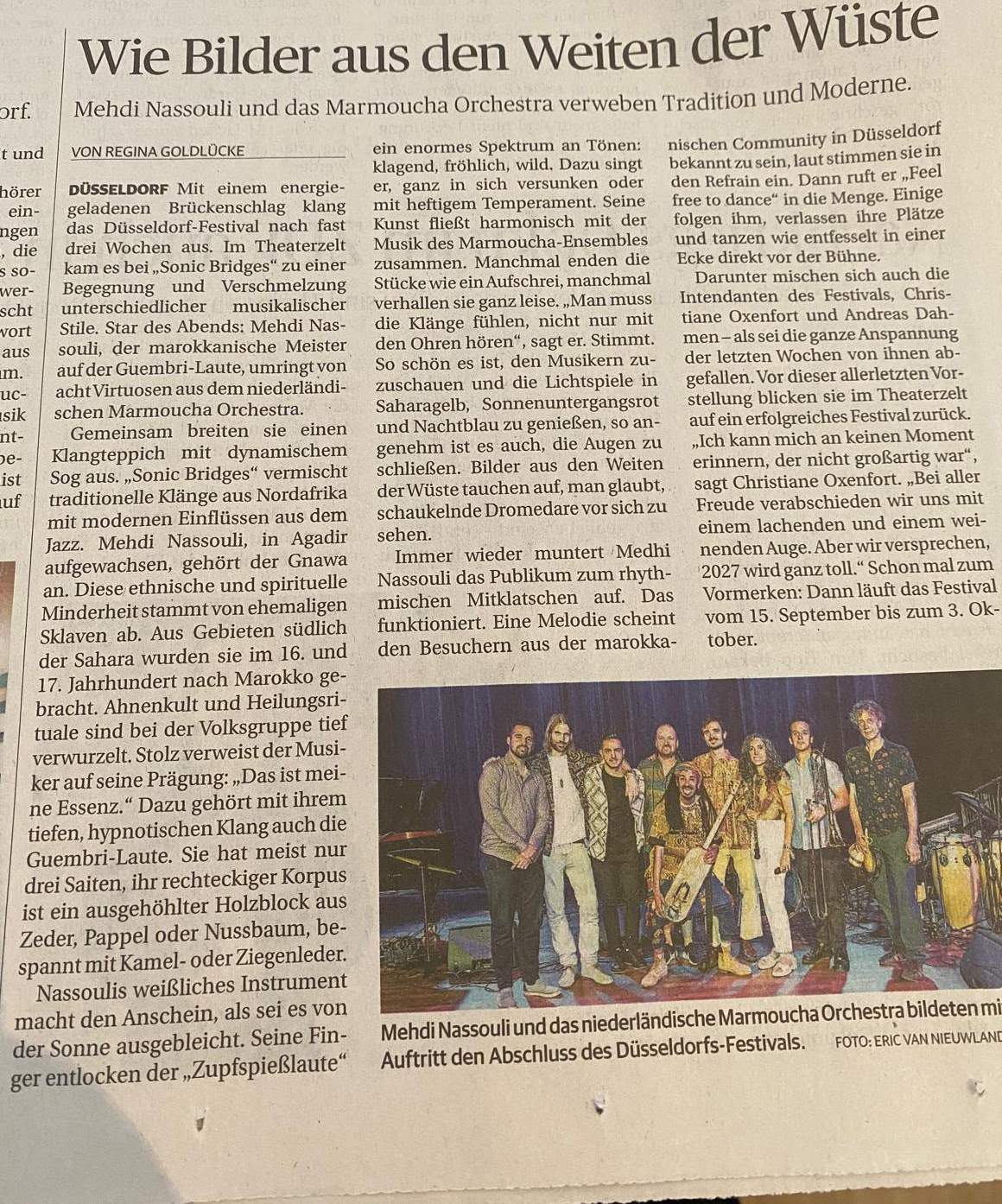
Door Regina Goldlücke
05.10.2026 – Düsseldorf: Met een energieke muzikale brug tussen verschillende werelden kwam het Düsseldorf Festival na bijna drie weken ten einde. In de theatertent vond met Sonic Bridges een ontmoeting en versmelting van uiteenlopende muziekstijlen plaats. Ster van de avond: Mehdi Nassouli, de Marokkaanse meester op de guembri, omringd door acht virtuoze musici van het Nederlandse Marmoucha Orchestra.
Samen creëerden ze een rijk muzikaal geheel met een meeslepende dynamiek. Sonic Bridges vermengt traditionele klanken uit Noord-Afrika met moderne invloeden uit de jazz.
Mehdi Nassouli, opgegroeid in Agadir, behoort tot de Gnawa. Deze etnische en spirituele minderheid stamt af van voormalige tot slaaf gemaakte mensen die in de 16e en 17e eeuw vanuit gebieden ten zuiden van de Sahara naar Marokko werden gebracht. Voorouderverering en genezingsrituelen zijn diep geworteld in deze gemeenschap.
Trots verwijst de musicus naar zijn achtergrond: “Dat is mijn essentie.” Daarbij hoort ook de guembri, met zijn diepe, hypnotiserende klank. Het instrument heeft doorgaans slechts drie snaren. De rechthoekige klankkast bestaat uit een uitgehold blok hout van ceder, populier of walnoot, bespannen met kamelen- of geitenleer.
Nassouli’s witachtige instrument ziet eruit alsof het door de zon is verbleekt. Zijn vingers ontlokken aan de getokkelde luit een enorm scala aan klanken: klagend, vrolijk, wild. Daarbij zingt hij, soms volledig in zichzelf gekeerd, dan weer met een vurig temperament.
Zijn muzikale kunst vloeit harmonieus samen met die van Marmoucha Orchestra. Soms eindigen de stukken als een schreeuw, soms sterven ze heel zachtjes weg. “Je moet de klanken voelen, niet alleen met je oren horen”, zegt hij. En dat klopt. Hoe mooi het ook is om naar de musici te kijken en te genieten van het lichtspel in Saharageel, zonsondergangrood en nachtblauw, zo aangenaam is het ook om de ogen te sluiten. Beelden van de uitgestrekte woestijn doemen op, alsof je schommelende dromedarissen voor je ziet. Steeds opnieuw spoort Mehdi Nassouli het publiek aan om ritmisch mee te klappen. En dat werkt. Een melodie lijkt bekend bij bezoekers uit de Marokkaanse gemeenschap in Düsseldorf. Luidkeels zingen ze het refrein mee. Dan roept hij “Feel free to dance” naar het publiek. Enkelen geven gehoor aan zijn oproep, verlaten hun plaatsen en dansen uitbundig in een hoek vlak voor het podium.
Ook de festivaldirecteuren Christiane Oxenfort en Andreas Dahmen mengen zich onder de dansers, alsof alle spanning van de afgelopen weken van hen is afgevallen. Voorafgaand aan deze allerlaatste voorstelling blikken ze in de theatertent terug op een geslaagd festival. “Ik kan me geen enkel moment herinneren dat niet geweldig was”, zegt Christiane Oxenfort. “Ondanks alle vreugde nemen we afscheid met een lach en een traan. Maar we beloven dat 2027 fantastisch wordt.”
Om alvast in de agenda te zetten: het festival vindt dan plaats van 15 september tot en met 3 oktober.
Bron: Rheinische Post, Regina Goldlücke
Vertaling: Met behulp van ChatGPT (OpenAI)
Online versie door Rheinische Post: https://rp-online.de/kultur/mehdi-nassouli-und-das-niederlaendische-marmoucha-orchestra-beim-duesseldorf-festival_aid-155973027
Like Images from the Vast Expanse of the Desert
Mehdi Nassouli and Marmoucha Orchestra weave together tradition and modernity.
By Regina Goldlücke
05.10.2026 – Düsseldorf: The Düsseldorf Festival drew to a close after almost three weeks with an energetic musical bridge between different worlds. In the festival’s theatre tent, Sonic Bridges brought together and blended a variety of musical styles. The star of the evening was Mehdi Nassouli, the Moroccan master of the guembri lute, surrounded by eight virtuoso musicians from the Netherlands-based Marmoucha Orchestra.
Together, they created a rich tapestry of sound with a compelling, dynamic pull. Sonic Bridges blends traditional sounds from North Africa with modern jazz influences.
Mehdi Nassouli, who grew up in Agadir, belongs to the Gnawa community. This ethnic and spiritual minority is descended from formerly enslaved people who were brought to Morocco from regions south of the Sahara during the 16th and 17th centuries. Ancestor worship and healing rituals are deeply rooted in the community.
The musician proudly refers to his heritage: “That is my essence.” Central to this heritage is the guembri, with its deep, hypnotic sound. The instrument usually has just three strings, while its rectangular body is made from a hollowed-out block of cedar, poplar or walnut wood, covered with camel or goatskin.
Nassouli’s whitish instrument looks as though it has been bleached by the sun. His fingers draw an extraordinary range of sounds from the plucked lute: plaintive, joyful, wild. He sings along, sometimes completely absorbed in himself, at other times with fiery passion.
His artistry blends harmoniously with the music of Marmoucha Orchestra. Sometimes the pieces end like a cry, while at other times they fade away almost inaudibly. “You have to feel the sounds, not just hear them with your ears,” he says. And he’s right. As beautiful as it is to watch the musicians and enjoy the lighting in Sahara yellow, sunset red and midnight blue, it is equally pleasurable to close your eyes. Images of the vast desert emerge, and you can almost imagine dromedaries swaying before you. Time and again, Mehdi Nassouli encourages the audience to clap along to the rhythm. And it works. One melody seems familiar to members of Düsseldorf’s Moroccan community, who enthusiastically join in the chorus. Then he calls out to the crowd: “Feel free to dance.” Some take him up on the invitation, leaving their seats to dance with abandon in a corner directly in front of the stage.
Among the dancers are the festival directors, Christiane Oxenfort and Andreas Dahmen, as though all the tension of the past few weeks has finally fallen away. Before this very last performance, they look back on a successful festival in the theatre tent. “I can’t remember a single moment that wasn’t wonderful,” says Christiane Oxenfort. “Despite all the joy, we say goodbye with mixed emotions. But we promise that 2027 will be fantastic.”
A date for the diary: next year’s festival will run from 15 September to 3 October.
Source: Rheinische Post, Regina Goldlücke
Translation: With assistance of ChatGPT (OpenAI)